
Postal context
Because of the hostile situation within the Boer Republics of Stellaland and Goshen, both of which were situated in what was regarded as British territory, the British Government sent Major-General Sir Charles Warren with an expeditionary force to resolve the situation and facilitate the annexation of the two Republics.
With a force of 4000 assembled in Cape Town Warren reached Vryburg, the principal town of Stellaland, in February 1885 and was able to peacefully reach agreement that both Republics would be incorporated into British Bechuanaland, which was declared to be a Crown Colony on 30 September 1885, comprising the territory South of the Molopo River. At the same time the rest of Bechuanaland to the North of the river was declared as a British Protectorate,.
During the period from 1885-1895 stamps and postal stationery of the Cape of Good Hope and Great Britain were overprinted BRITISH BECHUANALAND for use in both territories, together with stamps specially printed using the “unappropriated die” designs. From August 1888 these stamps were additionally overprinted for use in the Protectorate.
On 16 November 1895 British Bechuanaland was annexed to the Cape Colony and the British Bechuanaland stamps and stationery were no longer valid there but remained valid in the Protectorate until 31 March 1933, following the issue of the Cattle and Baobab Tree definitive issue on 12 December 1932. The Bechuanaland Protectorate overprints continued to be valid until 8 February 1938 but are seldom seen used after 1932.
British Bechuanaland
Stamps for British Bechuanaland were issued in a variety of formats. The first issue comprised overprints on Cape of Good Hope stamps in 1885. The ½d orange stamp (No. 1 below) was issued in 1887 as part of a longer set of 13 with the other 12 denominations using the unappropriated design; there was no ½d design in that design so the current British ½d was overprinted. The other values below (Nos. 2-6) were issued 4 years later, with more overprints on the Cape of Good Hope stamps in the years between and in 1893. In 1918 the 1s British Bechuanaland Queen Victoria 1s keytype was surcharged “£5” for use as a revenue in Bechuanaland Protectorate, though postally used examples are known.[1]
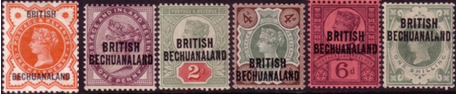
| (SG №) | denomination | colour | date of issue | number issued |
| 9 | ½d | orange | 1 November 1887 | 515,040 |
| 33 | 1d | lilac | 1 December 1891 | 624,480 |
| 34 | 2d | red and green | 1 December 1891 | 596,280 |
| 35 | 4d | green and brown | 1 December 1891 | 250,800 |
| 36 | 6d | purple on red | 1 December 1891 | 175,920 |
| 37 | 1s | green | July 1894 | 79,920 |
A 3d value was prepared for use but not issued, though copies overprinted “SPECIMEN” exist.
The other values were not issued with control letters.
No further stamps were issued before incorporation into Cape of Good Hope.
Bechuanaland Postal Stationery
From 1886 the postal stationery cards, wrappers and registration envelopes of the Cape of Good Hope were overprinted for use in Bechuanaland and later the overprinted GB stationery was used and continued to be used as stocks endured after the 1932 introduction of Bechuanaland Protectorate stationery.
The Bechuanalands Postal Stationery is well described in “The Postal Stationery of the Bechuanalands and Botswana” by Peter Tye and John Inglefield-Watson published by the British Philatelic Trust in 2004. The GB overprinted stationery is comprehensively described in the GBOS publication ‘Overprinted British Postal Stationery’ written by Dr John Gledhill, with details of all varieties.
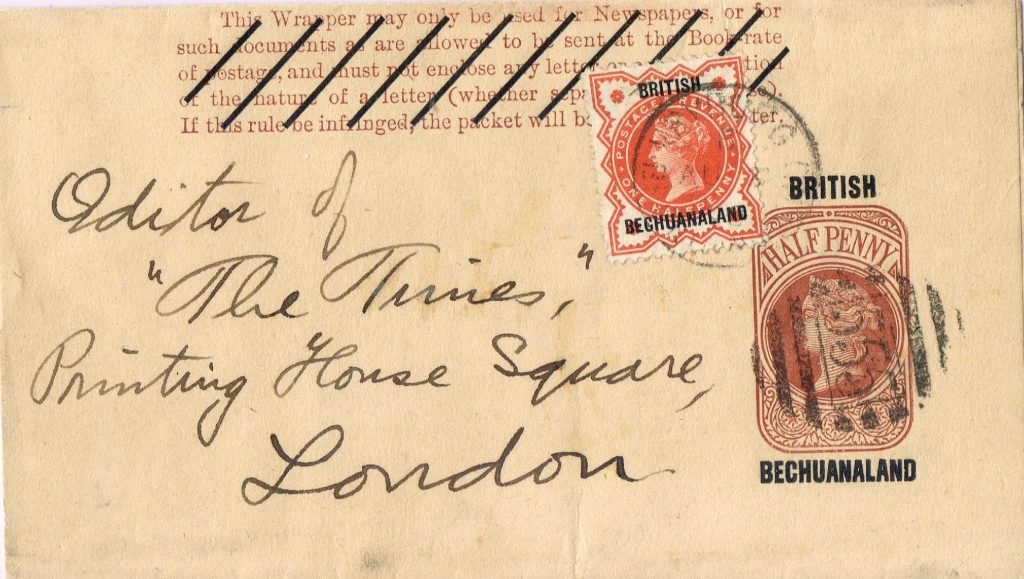
The illustrated GB wrapper is the 1885 QV half-penny wrapper with five lines of instructions dispatched from Vryburg to London. The wrapper is overprinted ‘BRITISH BECHUANALAND’ and the five lines of instructions obliterated with bars. The wrapper is uprated with the QV half-penny vermilion overprinted ‘‘BRITISH BECHUANALAND’” and this variant of the wrapper with five lines of instructions is seldom found used.
Bechuanaland Protectorate
The area north of the Molopo River was declared a British Protectorate (reportedly at the request of the local chiefs) on 30 September 1885, at a time of tribal conflicts. The protectorate continued to use overprinted stamps of Britain, Cape of Good Hope, and British Bechuanaland until 12 December 1932 when an inscribed set was issued. The protectorate was granted self-government in 1965 and became independent as “Botswana” in 1966.
The Bechuanaland Protectorate is not the same territory as the adjacent “British Bechuanaland” but both postal services were administered from Mafeking in British Bechuanaland, and both territories used each other’s stamps.British Bechuanaland is the area south of the Molopo River, declared a crown colony on 30 September 1855 comprising Stellaland, Goshen and other adjacent territories. On 16 November 1895 the colony was incorporated into Cape of Good Hope
This chapter only covers the issues which were overprinted on British stamps.
Stamps for Bechuanaland Protectorate were issued in a variety of formats. The ½d orange stamp (No. 1 below) was issued in 1888 as part of a longer set of 11 with the other 10 denominations using the British Bechuanaland unappropriated design values overprinted “Protectorate”; there was no ½d design in that design so the current British ½d was used. Cape of Good Hope stamps were overprinted in 1889 and 1897, with the two former trial overprints (Nos. 2-3 below) coming into use in 1890. From October 1897 only overprinted British stamps were issued until the pictorial definitive issue of 1932. No South African postage stamps were overprinted for Bechuanaland for postal use, but South African King Edward VII 6d and King George V ½d and 1d postage stamps were overprinted “BECHUANALAND PROTECTORATE” for revenue use, though are also known used unofficially for postage.
The first Queen Victoria issue, with additional local overprint “Protectorate”
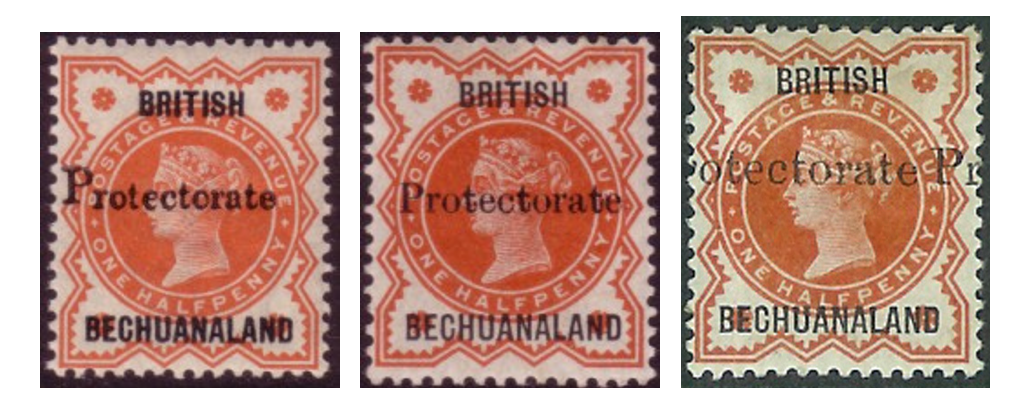
| (SG №) | denomination | colour | overprint | date of issue | number issued |
| 40 | ½d | orange | 15½mm opt | 7 August 1888 | not recorded |
| 54 | 15mm opt | 1890 | not recorded | ||
| 55 | 19mm opt | 1890 | 840 |
Nos 2 and 3 were trial overprints made in 1888, were released in 1890 because of a shortage of No 1. All three stamps listed above received the “Protectorate” overprint locally, on current stocks of the British Bechuanaland stamp, and no records were kept of the quantities issued with the overprints. The quantity for the 19mm overprint is deduced from the copies known (3½ sheets, according to the study by HR Holmes). The 19mm overprint proved much too wide for the stamp and is usually found misplaced horizontally. The 15mm overprint can be distinguished from the main 15½mm issue by the latter having the “P” misplaced upwards; it is tempting to speculate that the capital “P” in the 15mm version was felt to be too small and was replaced by a larger font which didn’t quite match, thereby creating the 15½mm version with its misplaced “P”.
Because they were trial overprints the printers had not worried particularly about any misprints which occurred; as a result errors are quite varied. In the case of No 2 the stamp is actually easier to acquire with an inverted overprint than with an upright one.
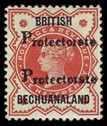
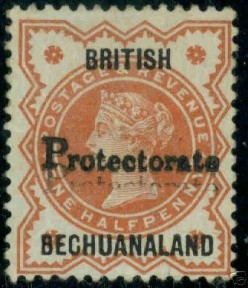
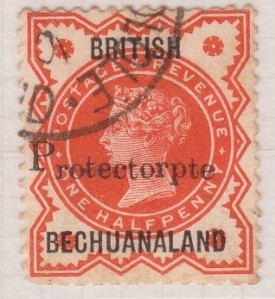
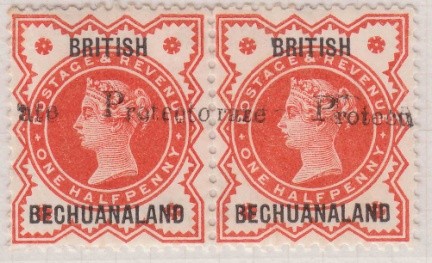
| Varieties | 15½mm overprint (raised “P”) | |
| 40.v1 | “Protectorate” double | The overprints must be clearly separated to meet this description, not a “kiss-print” or “bounce” |
| 40.v2 | “Protectorate” triple | |
| 40.v3 | “Protectorpte” | |
| 40.v4 | “Protectorate” misplaced |
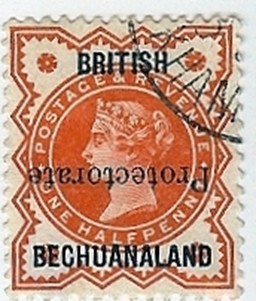
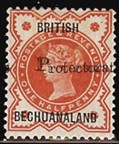
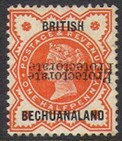
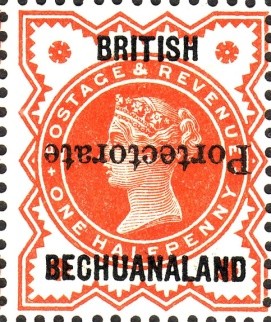
Misplaced or defective letters can be found, for example:
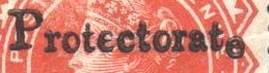
| Varieties | 15mm overprint (“P” in line) | |
| 41.v1 | “Protectorate” inverted | |
| 41v2 | “Protectorate” double | |
| 41.v3 | “Protectorate” double and inverted | |
| 41.v4 | “Portectorate” (inverted) | Only recorded inverted |
| 41.wi | watermark inverted |
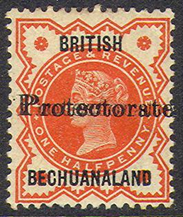
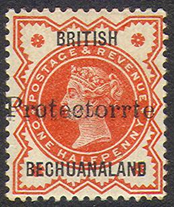
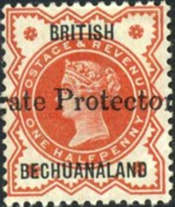
| Varieties | 19mm overprint | |
| 3.v1 | “Protectorate” double | |
| 3.v2 | “Protectorrte” | |
| 3.v3 | “Protectorrte” double | |
| 3.v4 | Overprint very misplaced | Small displacements are normal as the word “Protectorate” was made too wide |
4d provisional
The overprint “Protectorate” with “Fourpence” was a composite overprint, not “Fourpence” added to stamps already overprinted “Protectorate”.
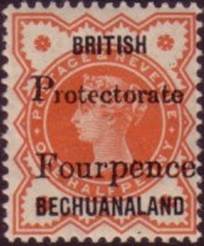
| (SG №) | denomination | colour | overprint | date of issue | number issued |
| 53 | ½d | orange | Protectorate Fourpence | August 1889 | not recorded |
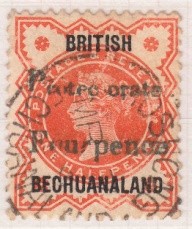
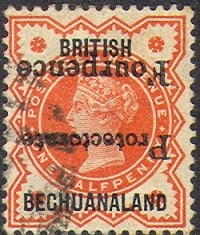
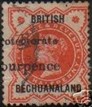
| Varieties | Fourpence provisional | |
| 53.v1 | Overprint in greenish black | |
| 53.v2 | “Protectorate Fourpence” inverted | |
| 53.v3 | “Protectorate Fourpence” badly misplaced | |
| 53.v4 | “ourpence” omitted | These errors come from a small part of one printing, on stamp R9/2 (The Overprinter 1990/2); some examples are known with “Fou” misaligned with “rpence”, which may be related to this error. |
| 53.v5 | “rpence” omitted |
The provisional overprint was applied in one pass, it is not the main issue with an additional “Fourpence” overprint. The printer did not clean his ink rollers properly after preparing some stamps for an unrelated overprint, resulting in the black ink of this overprint having a green tinge. There are frequently defective letters.
Examples with “Protectorate” double or inverted but “Fourpence” normal, or the whole overprint inverted and misplaced to read “Fourpence Protectorate” (with incorrect spacing), are regarded as contemporary forgeries, some of which passed through the post (Holmes p.89).
London overprint
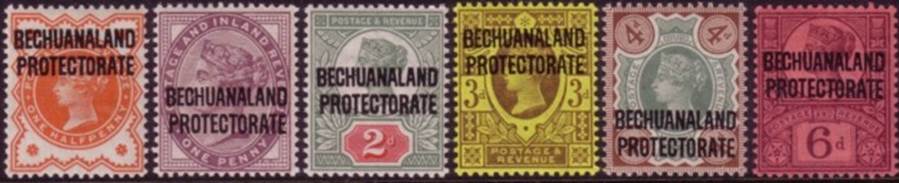
| (SG №) | denomination | colour | date of issue | number issued |
| 59 | ½d | orange | October 1897 | 473,760 |
| 61 | 1d | lilac | October 1897 | 591,600 |
| 62 | 2d | red and green | October 1897 | 544,080 |
| 63 | 3d | purple on yellow | December 1897 | 136,800 |
| 64 | 4d | green and brown | October 1897 | 115,400 |
| 65 | 6d | purple on red | October 1897 | 100,320 |
Changed colour
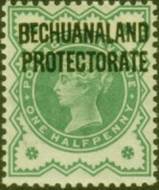
| (SG №) | denomination | colour | date of issue | number issued |
| 60 | ½d | green | 25 February 1902 | 213,600 |
King Edward VII
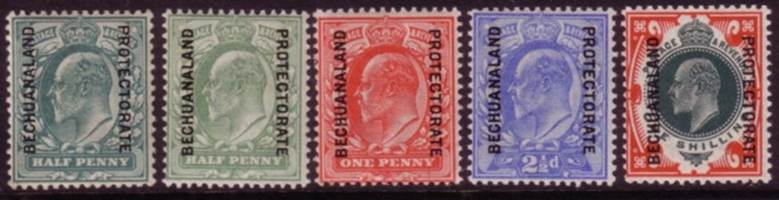
| (SG №) | denomination | colour | date of issue | number issued |
| 66 | ½d | dark green | March 1906 | 179,800 |
| 67 | ½d | pale green | November 1908 | 316,320 |
| 68 | 1d | red | April 1905 | 1,229,280 |
| 69 | 2½d | blue | 29 November 1904 | 116,640 |
| 70 | 1s | red and green | December 1912 | not recorded |
Nos 12-15 are De La Rue printings; No. 16 is a Somerset House printing.
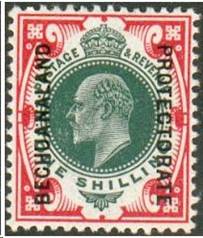
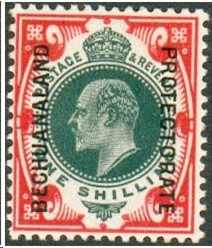
No. 16 changed from carmine to scarlet in 1913.
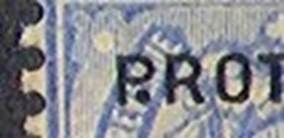
| Varieties | ||
| 69.v1 | 2½d | spot under the “P” of Protectorate |
| 70.v1 | 1s | overprint double, one albino |
King George V, Downey head, 1912
Wmk Crown, die II
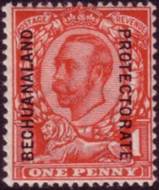
| (SG №) | denomination | colour | date of issue | number issued |
| 72 | 1d | red | September 1912 | not recorded |
King George V, script watermark
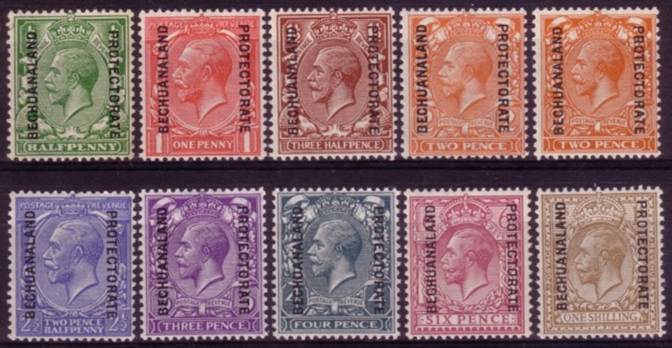
| (SG №) | denomination | colour | date of issue | number issued |
| 73 | ½d | green | 1 July 1913 | not recorded |
| 74 | 1d | red | April 1915 | not recorded |
| 75 | 1½d | brown | December 1920 | not recorded |
| 76 | 2d die I | orange | January 1914 * | not recorded |
| 77 | 2d die II | orange | 1924 | not recorded |
| 78 | 2½d | blue | 1 July 1913 | not recorded |
| 79 | 3d | violet | 1 July 1913 | not recorded |
| 80 | 4d | green-grey | 1 July 1913 | not recorded |
| 81 | 6d | purple | 1 July 1913 | not recorded |
| 82 | 1s | brown | 1 July 1913 | not recorded |
* The colour of the 2d die I was changed deliberately from yellow-orange to red-orange in November 1913, so the issue date given as “1 July 1913” in the major catalogues for the Bechuanaland overprint is suspect as no copies are known in the then-current yellow‑orange colour. The earliest recorded control for the Bechuanaland 2d is C14, which was first used in January 1914, which is therefore the date given above. Subject to further research.
* these controls have so far only been seen in the BPMA archive with this perforation.
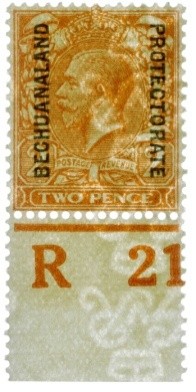
| Varieties | ||
| 76.wi | 2d die I | watermark inverted |
| 76.v1 | 2d die I | overprint double, one albino |
| 81.v1 | 6d | overprint double, one albino |
King George V, high value “Seahorses”
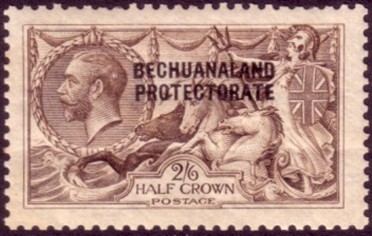
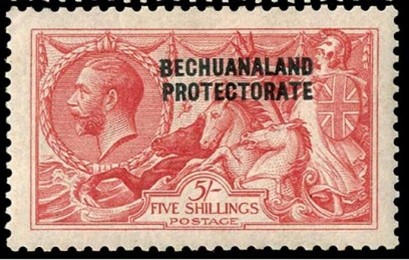
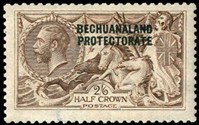
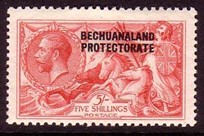
Three printers were involved over a period of 18 years. Waterlow 1914-1916, De La Rue July 1916-1923, Bradbury Wilkinson July 1920-1932.
Waterlow
De La Rue
Bradbury Wilkinson
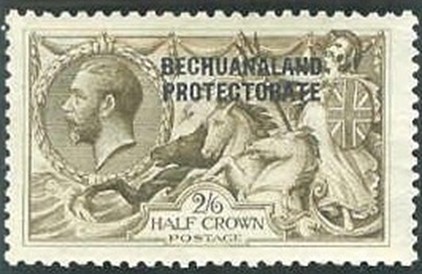
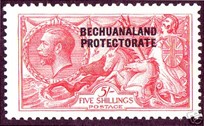
| (SG №) | denomination | colour | date of issue | number issued | |
| Waterlow | |||||
| 83 | 2/6d | brown | January 1915 | not recorded | |
| 84 | 5s | red | 1914 | not recorded | |
| De La Rue | |||||
| 85 | 2/6d | brown | July 1916 | not recorded | |
| 87 | 5s | red | August 1919 | not recorded | |
| Bradbury Wilkinson | |||||
| 88 | 2/6d | brown | July 1923 | not recorded | |
| 89 | 5s | red | July 1920 | not recorded |
| Varieties | ||
| 83.v1 | 2/6d Waterlow | overprint double, one albino |
| 83.v2 | 2/6d Waterlow | major re-entry (R2/1) |
| 84.v1 | 5s Waterlow | overprint double, one albino |
| 85.v1 | 2/6d De La Rue | overprint treble, two albino |
| 85.v2 | 2/6d Waterlow | major re-entry (R2/1) |
| 87.v1 | 5s De La Rue | overprint double, one albino |
| 88.v1 | 2/6d Bradbury Wilkinson | overprint double, one albino |
| 88.v2 | 2/6d Bradbury Wilkinson | overprint treble, two albino |
| 88.v3 | 2/6d Waterlow | major re-entry (R1/2) |
| 89.v1 | 5s Bradbury Wilkinson | overprint double, one albino |
| 89.v2 | 5s Bradbury Wilkinson | overprint treble, two albino |
King George V, block watermark
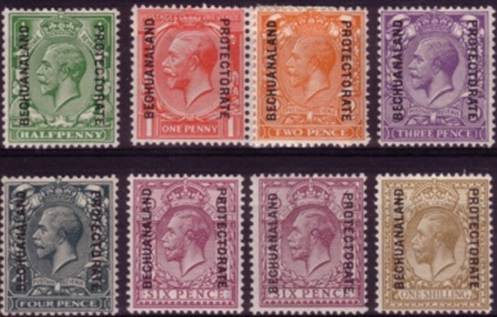
| (SG №) | denomination | colour | date of issue | number issued |
| 91 | ½d | green | 1927 | not recorded |
| 92 | 1d | red | August 1925 | not recorded |
| 93 | 2d die II | orange | July 1925 | not recorded |
| 94 | 3d | violet | October 1926 | not recorded |
| 95 | 4d | green-grey | October 1926 | not recorded |
| 96 | 6d chalky paper | purple | December 1925 | not recorded |
| 97 | 6d ordinary paper | 1926 | not recorded | |
| 98 | 1s | brown | October 1926 | not recorded |
* 6d control D.25 reported in Holmes but not yet confirmed
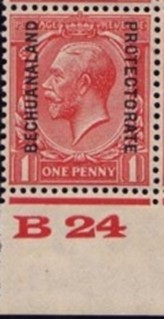
| Varieties | ||
| 93.wi | 2d | watermark inverted |
| 94.v1 | 3d | overprint double one albino |
| 94.v2 | 3d | overprint double one albino, and watermark inverted |
| 95.v1 | 4d | printed on the gummed side |
| 98.wi | 1s | watermark inverted |
Postage dues
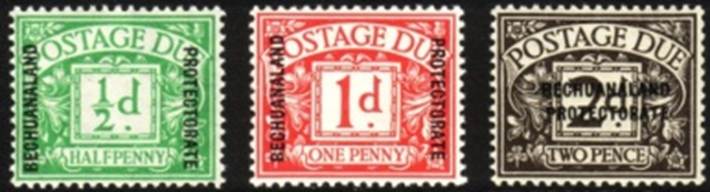
| (SG №) | denomination | colour | date of issue | number issued |
| D1 | ½d | green | January 1926 | not recorded |
| D2 | 1d | red | January 1926 | not recorded |
| D3 | 2d | black | January 1926 | not recorded |
½d: block watermark, sideways inverted
1d: script watermark, chalky paper
2d: block watermark, sideways
On 12 December 1932 a set inscribed for Bechuanaland Protectorate was issued, including postage dues.
References specific to this chapter
GBOS GB Overprints Compendium edition 8, Dr John Gledhill (12/4/2020)
Particular thanks go to Stanley Gibbons Ltd, for permission to quote their catalogue numbers and numerous other contributors who are mentioned in the Appendix section.
All content is copyright, Dr John Gledhill and the GB Overprints Society, May 2025.
Holmes HR, The Postage Stamps, Postal Stationery and Postmarks of the Bechuanalands
Our thanks go to Brian Hurst for images of several scarce varieties.
[1] J Barefoot catalogue “British Commonwealth Revenues” under Bechuananald Protectorate,No. 38